Baptism of Our Lord, year A
Listen to homily here:
Read homily here:
You may have noticed, either by coming to Mass or by looking at our email bulletin, that we have had a good number of baptisms in recent years. Every year around this time, we are required to make records of these things and send them to the Archbishop’s office. All of this data is then collected and forwarded to Rome.
So I had to add up the number of baptisms we had last year here at St. Peter’s, which came, if my arithmetic is correct, to sixty-seven. I was quite surprised by that number. Of course, in the Church we also love record-keeping, and here at St. Peter’s we have parish registers going all the way back to the founding of the parish in 1860. I began looking through those books to see when the last time was that we had this many baptisms in a single year. What I discovered was that the last time we had this number was in 1982, which, somewhat ironically, was around the time that I myself was baptized in this parish.
That is quite a while ago, and it is truly a blessing for all of us. It reflects the fact that many new families are coming to New Westminster and joining our parish community. It is a blessing, and it is also an opportunity for us to pause and reflect on our own baptism and on the great gift that baptism is in our lives.
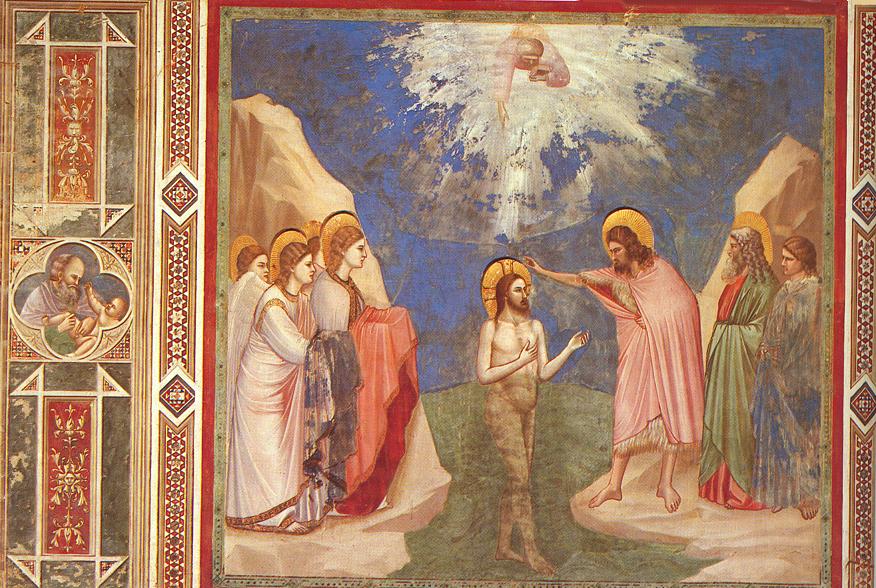
On this feast that we celebrate today, the Baptism of the Lord, the Church gives us a unique opportunity to consider our own baptism, its meaning, and how in baptism we receive both an identity and a mission in Jesus Christ.
The early writers of the Church loved to speak very poetically about this event. The baptism of Jesus struck them, as it does us, as a profound paradox. How is it that Jesus Christ, who is God, comes to be baptized by John, a human being? How is it that the one who is without sin submits himself to baptism? These early writers often described how Christ’s baptism allows something extraordinary to happen for each and every one of us, and they expressed this mystery with rich and beautiful language. I would like to share some of that language with you this morning.
Saint Ephrem, who lived around the year 350 in Syria, was a deacon, theologian, and one of the great poets of the early Church. He wrote many hymns that are still used today, especially in Syriac-speaking churches. Writing about this feast, he says:
“The River Jordan trembled
when it saw the Lord within its depths.
Fire entered the water,
and the water did not burn.
The voice of the Father thundered,
the Son stood in the Jordan,
the Spirit hovered like a dove,
one mystery revealed in three signs.”
Around the same time, another great writer of the Church, Saint Gregory of Nazianzus, writing in the fourth century, reflects on this mystery in these words:
“Christ is illumined. Let us shine forth with him.
Christ is baptized. Let us descend with him,
that we may also rise with him.
The heavens were opened, because the heavens were closed to us.
The Spirit descended, because he was exalting our nature.
The voice bore witness, because he was being borne witness to.”
And finally, Saint Maximus of Turin, who was bishop of Turin around the year 420, offers this brief but powerful statement:
“The Savior wills to be baptized, not that he might be cleansed, but that the waters might be cleansed by him.”
Through these voices, the early Church helps us see that in the mystery of Christ’s baptism, Jesus is preparing the way for our own baptism. He enters the waters so that we might receive this central sacrament, a sacrament that changes our lives.
Some fifteen hundred years later, the Church gathered for the Second Vatican Council, the most recent ecumenical council of the Church. Ecumenical councils are moments of profound teaching, when bishops from around the world gather to reflect on the life of the Church and to articulate the faith anew in light of the present moment. Pope Francis has recently begun a catechetical series reflecting on the documents of the Second Vatican Council, highlighting their enduring relevance for us today.
One of the most important documents of the Council is Lumen Gentium, which means “Light to the Nations.” This document speaks powerfully about what baptism does for us. As we see in the Gospel today, baptism touches something fundamental about identity. When Jesus descends into the water, his identity is affirmed. He is revealed as the Son of God.
In our baptism, the same thing happens to us. Through Christ, we receive an extraordinary dignity. We become sons and daughters of God. In the ancient world, the family to which one belonged made all the difference. It shaped one’s place in society and one’s entire future. In baptism, we receive a new identity and a radical equality. We are all sons and daughters of God, sharing the same grace and the same life.
Lumen Gentium, number ten, states: “The baptized are consecrated to be a spiritual house and a holy priesthood.” Through baptism, we receive our name and identity, and we also come to belong to the Church, and therefore to one another.
The Second Vatican Council emphasizes that baptism is our most fundamental vocation. At times in the past, there may have been a sense that some Catholics were more important than others, perhaps clergy or religious. While each of us has a distinct vocation, Lumen Gentium reminds us that baptism is the first and most important calling we receive. It is through baptism that we belong to the Body of Christ, and therefore every person matters. There are no passive spectators in the Church.
Lumen Gentium, number thirty-two, says, “There is a true equality in dignity and action among all the faithful.” In baptism, we become part of the Body of Christ, and each of us has a role to play in the mission of Jesus.
Finally, baptism does not only give us identity and dignity. It also gives us mission. By baptism, we become part of the Body of Christ, and the Church continues the mission of Jesus in the world. We are called to help build the Kingdom of God, a kingdom of justice, peace, and love.
Lumen Gentium, number thirty-one, teaches that the baptized, by their very vocation, seek the Kingdom of God by engaging in the affairs of the world and ordering them according to God’s plan. Because we are baptized, we are sent back into our families, workplaces, schools, and communities with new eyes, called to shape these places according to God’s vision.
Baptism gives us an identity as sons and daughters of God, confers great dignity, incorporates us into the Church, and sends us on mission. For this reason, it is important to remember our own baptism and even to celebrate it.
I love a piece of advice Pope Francis gave early in his pontificate. He asked people, “Do you know the date on which you were baptized?” If you do not know it, he said, find out. Put it in your calendar. Mark it in some way. It is an incredible day in our lives.
Perhaps that is our challenge today, as we reflect on the Baptism of the Lord and what it means for us. Do we know the day on which we were baptized, and if we do, how are we remembering and celebrating that gift?
